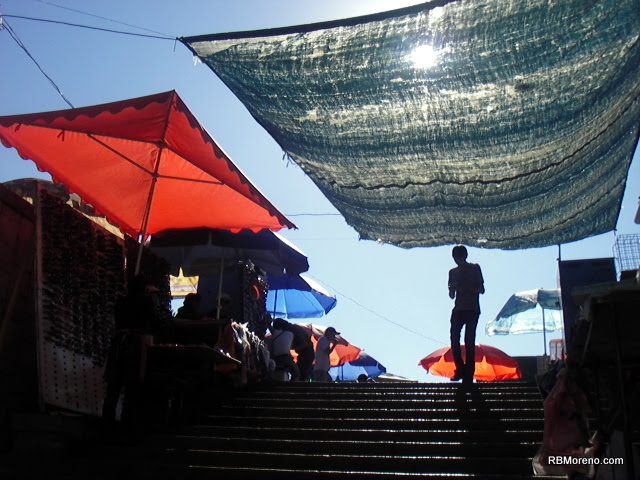
June 1, 2010 -- A toy tractor, rated for ages three and above, on sale at a supermarket outside Bishkek, Kyrgyzstan.
The U.S. military has stopped refueling tanker planes at its Manas air base in Kyrgyzstan as the U.S. renegotiates fuel prices with the Kyrgyz government, officials said Tuesday.From UPI, "Ethnic tensions simmer in Kyrgyzstan." An excerpt:
Pentagon spokesman Bryan Whitman and other U.S. military officials said flights continue to ferry military personnel and supplies to and from Afghanistan through Manas.
But in an effort to conserve fuel, officials said, the tanker planes used to refuel aircraft operating over the battlefields of Afghanistan are no longer stopping at Manas. Instead, the tankers are going elsewhere to pick up fuel.
"We are currently in discussions with the interim government to determine the optimal way to procure fuel in the future," Air Force Maj. John A. Elolf, a spokesman at the base said. "We have taken steps to conserve fuel at the transit center until the discussions are complete."
Operations at the base, which opened in December 2001, have long been the source of tension between the U.S. and Kyrgyzstan, a former Soviet republic. Several times, the Kyrgyz government appeared to be on the verge of closing it.
Hundreds of Uzbek security forces were sent to an Uzbek enclave in Kyrgyzstan as protesters demanded protection for Kyrgyz inhabitants, security forces said.From RFE/RL, "Anti-Bakiev Protesters On Hunger Strike In North Kyrgyzstan." An excerpt:
Security forces in Uzbekistan sent police and military troops to the Uzbek enclave of Sokh in Kyrgyzstan to greet area protesters ... Hundreds of residents in the enclave, one of the largest Uzbek enclaves in Kyrgyzstan, blocked a main highway to Uzbekistan to call for security for Kyrgyz citizens.
The protesters said several cars belonging to Kyrgyz citizens were damaged in the area in recent days.
Uzbek authorities closed the border with Kyrgyzstan following the April uprising that removed President Kurmanbek Bakiyev from power.
Seven residents of the city of Naryn in northern Kyrgyzstan have launched a hunger strike to demand that all associates of ousted former President Kurmanbek Bakiev be dismissed from official posts in the region, RFE/RL's Kyrgyz Service reports.From GlobalPost, "Kyrgyzstan's deceptive calm." An excerpt:
Bakiev was ousted after mass protests on April 7 and fled the country, initially to Kazakhstan. He is currently in Belarus at the invitation of Belarusian President Alyaksandr Lukashenka.
One of the protesters, Kanayim Berdibaeva, told RFE/RL that the hunger strikers will continue their protest for three days in Naryn. Then, if their demands are not met, they will march to Bishkek.
Naryn Deputy Mayor Chynara Abdraimova met with the hunger strikers but failed to dissuade them from their protest.
Kyrgyzstan remains a society deeply split along geographic, economic and ethnic lines. Bakiyev comes from Jalalabad in the south; the provisional government leaders who replaced him are predominantly from the north. Within the south, Kyrgyz and Uzbeks compete and at times come into conflict.From the IHT, an op-ed, "Democratic Change It's Not." An excerpt:
“All the ingredients are there for continued nasty business,” said Alexander Cooley, an associate professor of international relations at Barnard College in New York and an expert on the region.
For all its diminutive size — 5.5 million inhabitants and comparable territory to South Dakota — Kyrgyzstan nevertheless sometimes seems to be not one country, but many. Economically, the north is relatively more developed and seems closer in character to Kazakhstan, with which the Kyrgyz share strong ethnic ties. The south — separated from the north by two walls of mountains — is part of central Asia’s racially mottled Ferghana Valley and is more traditional. Close to half the population is Uzbek. Even the Kyrgyz living there are viewed as a different breed by their northern brethren.
Young people openly speak about the hard life in Kyrgyzstan. Revolutions have replaced economic growth. Stability has given way to full unpredictability, and opportunities for the young are scarce to nonexistent.And from TIME, a retrospective, "After a President's Ouster, Kyrgyzstan Remains in Crisis." An excerpt:
Otunbayeva, the country's interim president, has urged calm and insists her governance can lead toward reform. She says she won't run in the 2011 election as a sign of her commitment to that. But as chaos swirls, it's a promise Otunbayeva may not even have the chance to keep.


A market town to its very heart, [Osh's] bazaar has apparently occupied the same spot on the banks of the Akbura river for 2,000 years. The rich history of the oasis lies hidden beneath the avenues of socialism and little remains to be seen. History's cultures, religions, and wars have disappeared from memory. The founding of the city is variously attributed to Alexander the Great, the Prophet Suleiman and even Biblical Adam. The most enduring tale is that of Suleiman who, when he reached the blade of rock at its centre, shouted “khosh” (“that's enough”).Surrounding Osh is the Fergana valley, a verdant lowland renowned for its watermelons and framed by the Pamir Alay to the south and the Chatkal range to the north. With Uzbekistan just five miles to the west, enclaves also abound among the region's Uzbeks, Kyrgyz, Tajiks, Kurds, Uighurs, and other ethnicities. Physical isolation tends to exacerbate the valley's divisions, write Stewart and Weldon, along with "unemployement, poor housing, population pressure ... [and] the failure of the goverment to ensure fair and even distribution of land and resources."