Showing posts with label public radio. Show all posts

Thursday, September 15, 2011

What Happened Yesterday in Baghdad

via WLAJournal.com
RBM's essay "What Happened Yesterday in Baghdad," presented last fall at the U.S. Air Force Academy's War, Literature, and the Arts conference, is soon to be out in print. An excerpt:
Once, when I was young and intent on becoming a Texas cattleman who also apprehended bandits, my parents commissioned a sepia portrait at the county fair. For about $25, families could select frontier costumes and stand inside a saloon as flashbulbs illuminated the scene. My mother, pictured wearing ostrich feathers and a broach, refused to distribute the photo the following Christmas on account of liquor bottles visible in the background. But the original has hung for years in our hallway. The visage of the boy at her side is somehow indelible: my pudgy, adolescent jowls expressionless beneath a top hat, one small hand gripping a cane, the other pocketing a revolver. I hadn’t examined it closely until recently. Then, late one August night, I saw what looked like the same boy online, in another portrait titled Great Times Together.
To read this essay in full and others from Teri Carter, Leila Levinson, and Joseph Bathanti, as well as fiction and poetry, you can access WLA 23 via Google Books.

Thursday, July 08, 2010

The Hair in Your Texas Garlic Toast

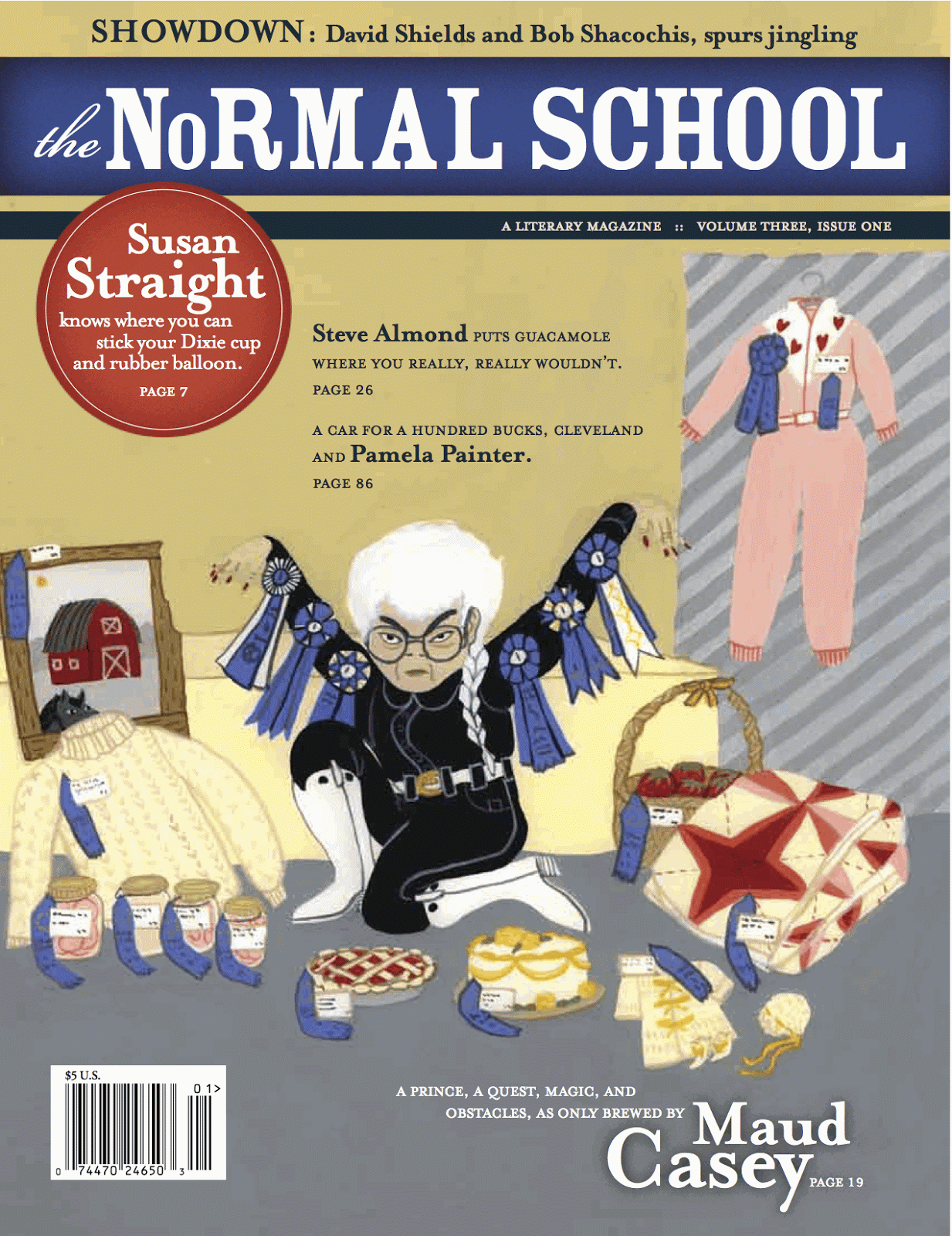
An essay by RBM about whether American groceries and garden supplies should contain human hair appears in the spring issue of The Normal School. The story won third prize among research and reporting-based essays at the 2009 Mayborn Literary Nonfiction Conference in Grapevine, Texas. It also appears in the 2010 volume of Ten Spurs, the conference's journal. Here's an excerpt from "The Hair in Your Texas Garlic Toast":
"DOUGH CONDITIONERS" reads the fine print on a bright blue box of Texas Garlic Toast. It’s made by Great Value, or GV ("When Quality Counts"). Wal-Mart, the product's distributor, describes GV as the country’s largest food brand in both sales and volume, and in March, 2009 announced an expansion. "At a time when families need to make every penny count," explained a company press release, new GV product lines, including thin-crust pizza, would provide Americans "with affordable, high-quality grocery and household consumable options comparable to national brands." (The Hartman Group, a marketing research firm, has called GV a "likely to purchase" label that outperforms other generic brands marketed by Wal-Mart as well as Kroger, Target, Albertsons, and Safeway.)

One night ... my roommate grabbed GV's Texas Garlic Toast from the scores of vertical freezers that line Wal-Mart SuperCenter no. 2729. Minutes ago I heated a few slices in the microwave near my desk and began to eat lunch. And just now, the moist, salted crust has reminded me, with a twinge, that this is exactly the kind of bread long sought by commercial bakers. Peering closely at the ingredients listed under dough conditioners, just before sugar but after yeast, I spot a familiar term: "L-CYSTEINE." Later, in the Encyclopedia of Food and Color Additives (1997), I find an American manufacturing association’s designation for L-Cysteine, based on U.S. Food and Drug Administration (FDA) guidelines: "status GRAS," or, generally recognized as safe.
To read free essays from the new issue by David Shields and Bob Shacochis, or (what else?) subscribe, visit the magazine's blog. For another excerpt from RBM's essay, check out this post.

Update (June 10, 2011) -- Journalist Scott Carney has just authored a 272-page investigation of the global human tissue trade, The Red Market: On the Trail of the World's Organ Brokers, Bone Thieves, Blood Farmers, and Child Traffickers. Here's an excerpt from NPR's write-up:
In his book, Carney also delves into the marketplace for human hair, known as "black gold."

"It is amazingly valuable," he says. "The market is about $900 million around the world, and about 40 percent of [that] hair is sold for human extensions."

Many of those transactions take place at the Sri Tirumala Temple in southern India, where people give their hair to the god Vishnu as an act of humility.

"I went there about two years ago and had my head shaved with probably about 1,000 other people," Carney says. "These women came, swept up the hair and threw it into these giant steel vats. [The hair] eventually gets combed and sorted and sold at an auction, and shipped out to the international market."

Hair collected in a single cut from a person's head, known as "remy," is used all over the world for hair extensions. But the shorter hair, often shorn from men, serves a very different purpose.

"Most of the hair that gets shorn is from men," Carney says. "That gets sold to chemical companies and gets reduced to an amino acid called L-cystine, which is used as a leavening agent in baking goods."

Tuesday, June 15, 2010

Exit Osh (Updated)

Volunteers reach the safety of a helicopter in Osh
By R.B. Moreno

I came to Central Asia to teach English, live among local people, and tell their stories. So this life in a compound near Bishkek that offers Gatorade and cable TV feels a bit unnerving. For the second time in as many months, I find myself behind barbed wire, along with other U.S. Peace Corps volunteers evacuated from provinces rocked by what newspapers have called ethnic cleansing. Our exit from Osh, Kyrgyzstan’s jewel of the South, says something about what is happening there.

Over two days, ten aid workers gathered in safe houses on both sides of the conflict. When our food ran low, neighbors smuggled us bread and tea and refused to be compensated. But others sent rocks through our windows and demanded bribes. And all the while, bands of young, ethnic Kyrgyz, enraged by rumors of students having been raped, terrorized the streets around us. They ransacked Uzbek apartments. They torched markets and restaurants. They burned vehicles, piled them into barricades, and shot at those trying to escape the city. By night, gunfire and screaming mixed with thunderclaps.

At last two hired cars arrived to get us to an airfield. The drivers wore bandanas; one carried a hatchet, another a hunting rifle. But there was confusion about where to rendezvous with another convoy. And so for 20 long minutes we sat exposed on burning Lenin Street. Smoke and sirens hung in the air. Rioters sped past carrying metal pipes, even a bow and arrow. Most of our cell phones didn’t work. Every time I shifted my legs, the volunteer pinned beneath me became asphyxiated. Another suggested running headlong toward a city park.

Presently, a dark sedan cruised by, pulled a U-turn, and came back for another look. Inside were three masked men and a Kalashnikov. This is what the trigger man wanted to know: Were there Uzbeks behind our tinted glass? “If any of you are Uzbeks we will kill you all,” he cried. No, no, just Americans, said the man with the hatchet. Show me, said the trigger man. And so my door was yanked open, and the trigger man raised his gun. For a moment we locked eyes – his glittering, angry, undecided. “No Uzbeks!” I repeated in Kyrgyz, my voice catching. Then the sedan's engine roared, and they were gone.

Minutes later we boarded a bus and began to roll slowly, behind a tank, through neighborhoods whose destruction we had only glimpsed earlier. Some passengers gasped at the shells of nightclubs, warehouses, and other landmarks now reduced to ashes. But other foreign nationals sitting alongside us – from Denmark and France, among other places – looked ecstatic. As if by magic, we were quitting what had become, overnight, a godforsaken place.

It wasn’t over yet. At the entrance to the airfield, another face-off, this time with scores of men agitating for weapons and furious about our convoy. Shouted questions filled the air. Who’s aboard the bus? Are they taking pictures? Rocks and sticks began to pelt our windows.

“Just smile at them,” said one woman. Instead, we cowered on the floor. And then the unthinkable happened: guns snatched from nervous troops huddled aboard the tank.

This is it, I thought to myself. What will a bullet feel like?

“I love you,” said another woman next to me, to her friend. Both began to cry.

A long volley rang out. But we could feel no pain. By some miracle these were warning shots, aimed at the clouds. Again an engine roared. And we were through.

As two helicopters lifted us skyward and circled Sulayman Mountain, a barren rock ringed by a cemetery that juts skyward from the middle of Osh, the scene became apocalyptic. Towers of black smoke marked Uzbek neighborhoods engulfed in flames. Much of the Cheremushki district appeared to have vanished. Some buildings glowed orange; others collapsed as we passed over head. Pushing north, with the sun setting, Osh became a terrible blur on the horizon.

It’s been three days since our evacuation, and for some, a creeping sense of guilt has begun to build. It comes in the form of a question no counselor can satisfactorily answer: By what twist of fate did we deserve to escape such carnage, while others perished? Two of the drivers who ferried us between safe houses, I'm told, were shot or beaten to death. Some 100,000 refugees have streamed west to safety in Uzbekistan, only to have the border shut and some of their children trampled in a stampede.

Calls to friends in Osh tell of still more suffering: empty food stalls at the bazaar; snipers picking off Uzbeks from atop Sulayman Mountain; a mother seven months pregnant dying of thirst on a rooftop; a Pakistani student, mistaken for an Uzbek, shot and beaten to death in the street. Although the official death toll stands at 138, locals tell of hundreds already buried and more bodies yet to recover.

“I wish I could have pushed some magic button that would have saved everyone,” one volunteer told me yesterday. “I can take no pride in having been evacuated.”


Postscript (July 1, 2010) -- After being removed temporarily at the request of the U.S. Peace Corps, this post has been republished. Excerpts are also available at NPR's blog.

Saturday, April 15, 2006

Wiccan Soldier's Widow Petitions for Recognition

Update: Over on NPR.org you can listen to a 2006 report by RBM on efforts to recognize the Wiccan pentacle as a government-approved burial marker. The feature aired on NPR's All Things Considered. An excerpt from the intro:
The widow of a Nevada National Guardsman killed in Afghanistan wants her husband's Wiccan faith recognized. The U.S. Department of Veterans Affairs permits 38 religious symbols to adorn headstones and memorials, like the one commemorating Sgt. Patrick Stewart's unit. That list includes the Christian cross and even a symbol for atheists, but the government has not yet approved the Wiccan pentacle.

Friday, March 10, 2006

Ward One Gentrification

Update: Over on the Internet Archive you can check out a 2006 report by RBM on changes coming to some of the District of Columbia's most densely-populated neighborhoods. The story was broadcast by WAMU 88.5 FM in Washington. An excerpt from the intro:
if you throw a dart at a map of the district, you're not likely to hit Ward One. It's not only the city's smallest ward, it's also the most diverse. Perhaps it's no wonder, then, that life in Columbia Heights, Mount Pleasant, and Adams Morgan is changing. As WAMU's Raul Moreno reports, gentrification is having a profound impact on Ward-One schools, especially those serving DC's Latino community.

Tuesday, November 15, 2005

Khan Goes to Court

Update: Over on the Internet Archive you can check out a 2005 report by RBM on conflict between military recruiters and college students, broadcast by WAMU 88.5 FM in Washington. An excerpt from the intro:
You've heard the stories: military recruiters for the all-volunteer armed forces are having trouble meeting their quotas. They're trying hard to attract young people - particularly students looking for a career. But not all students are eager to talk to a military recruiter. Case-in-point: an undergrad at George Mason University who's encouraging other students NOT to sign on the dotted line, and who's now in legal trouble because of it. He could face charges of trespassing and disorderly conduct next week in Fairfax after he handed out pamphlets that urged young people not to join the military. It's a legal issue that's drawing a lot of attention, as we hear from reporter Raul Moreno.

Wednesday, September 01, 2004

Judging the Impact: A Post 9-11 America

Update: Over on the Internet Archive you can view a briefing on post-September 11 governmental reforms co-authored by RBM, who interned for National Public Radio's National Desk over the summer. It was published online in July by NPR.org. An excerpt:
In the past three years, the nation's law enforcement and intelligence communities addressed vulnerabilities exposed by the Sept. 11 attacks. And the creation of the vast new Department of Homeland Security capped a massive reorganization of the federal government. But members of the 9-11 Commission say those reforms are insufficient.

Thursday, July 15, 2004

D.C. Sewer Overflows

Update: Over on the Internet Archive you can check out a report by RBM on Washington, DC's fragile sewer system. The feature aired on NPR's Intern Edition. An excerpt from the intro:
Washington, D.C., is a wet place. In 1791, President George Washington chose a piece of marshland for the nation's capital. Two rivers and an oversized creek run through the District, which averages over 40 inches of rain per year. When storms drench city streets, parking lots and rooftops, millions of gallons of water rush through an aging network of pipelines that combine runoff with raw sewage. As Intern Edition's Raul Moreno reports, the Anacostia River is suffering from this polluted mixture, and city managers are trying to fix the problem.