


Sulayman rises from an old city on the Silk Road and an arid expanse of farmland, and looks something like Horsetooth. Still, its five hills are made of quartz and lime, not sandstone, and I feel conspicuous in my shorts and trainers. This a place of pilgrimage, where colored prayers dangle from bushes and women in veils slide down a certain rock said to impart fertility.RBM's last dispatch from Osh can be found elsewhere on this blog and over at NPR.org.
Get on with it. What’s a foreigner doing in a cemetery?
The sun has nearly set but I want to find a running trail I can trust -- and get a look at the summit. I don’t know how to get there, but the path that snakes around some military barracks, on the west side, seems less taken. I work myself higher and higher along switchbacks, feeling my heartbeat climb into familiar territory. Burs rake at my legs as I lose the path, but the exertion is exquisite (and hard to find on the campus where I teach). I pass boulders covered in Kyrgyz and Russian graffiti, some with blue numerals that signal older markings -- hunters and the hunted, most predating the Qur'an. Finally, the path enters a draw and shoots straight up, toward a plateau where the sky seems brightest.
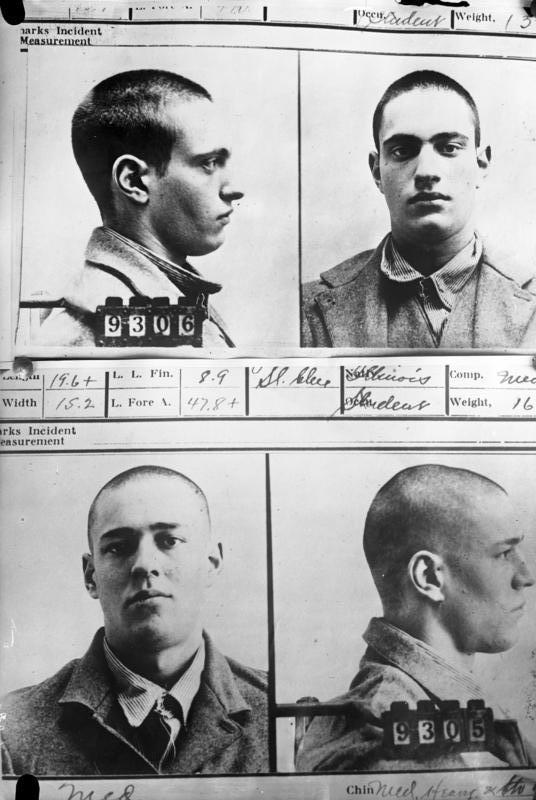 | |
| Top row: Nathan Leopold, ca. 1924 (via Wikipedia) |
RM: “The letter was an artifact,” you tell us, “like her wallet, wristwatch, key chain, social security card, also put away in a drawer -- a memento of my mother.” What compelled you, 29 years after her death, to examine it anew?For the rest of the interview, an excerpt from Shinner's essay, and RBM's earlier posts, visit the CLP Editor's Blog.
PS: I’ve had this letter for a long time, and from the very beginning was intrigued, puzzled, and moved by it. I’ve attached a certain amount of longing to it, my own longing. What did it mean? Who was the woman on the receiving end? The questions, the same questions, don’t stop coming. I tried writing about it before, but to no avail. I had nothing to push against the letter, no context or resistance or countervailing force. It wasn’t until I started searching for her letter, and immersed myself in the other letters, that something began to shift, that I could sense a gathering of momentum within myself, and simultaneously that I could go beyond myself, in fact needed to go beyond myself, to investigate the place or places where this personal history intersected the history of the larger world, which was very important for this essay. That’s the boundary I find interesting -- where personal concerns nudge or collide against the larger polis.
Ambitious storytellers, like the graduate students who keep our English Department’s printing lab busy at night, can soon have all kinds of literary magazines and blogs crowding their computer monitors. And when we read, after browsing Khimaira’s website, that our 30-page, Tolstoy-inspired novelette isn’t eligible for the journal’s 2011 Fantastiki Fiction Contest, whose guidelines call for a story of fewer than 5,000 words set in Ancient Greece, we may feel led astray.NewPages.com's LitPak can help writers avoid getting lost. Find this post and another by RBM at the CLP Editor's Blog.
 | |
| via Colorado State University |
to read the New York Times Book Review as of late is to get the impression that the age of nonfiction, like that of Rome or America, has overstepped its bounds. The literary world, according to Times editor Neil Genzlinger, has been inundated by “a sea of people you’ve never heard of, writing uninterestingly about the unexceptional, apparently not realizing how commonplace their little wrinkle is or how many other people have already written about it.” Genzlinger’s guide for “would-be memoirists,” which conveys the kind of hollow feeling I get from reading sex advice columns, comes in four partsTo read this post and an upcoming interview with one of the Review's nonfiction contributors, visit the CLP Editor's Blog.


 |
| Ganges Composition |


