Showing posts with label teaching. Show all posts

Wednesday, November 09, 2016

Fastwrite: Election Night

Nov. 9, 2016 -- This month, on the campus where I teach English, we're studying "living sources." Fieldwork, et cetera. Today I asked students to write for 10 minutes in a notebook about something or someone you've overheard in the past 24 hours. "Give your topic a face," Bruce Ballenger urges his curious and not-so-curious researchers. Here's what I got down.
North Portland. November 9, 2016. Corner bakery, big windows. 
The man sitting down the bench from me is on his phone. I can't make out the caller. His mother, maybe. He loves her very much—that much is clear. What's also obvious? This morning, this man is nearing some breaking point.
"You don't understand," says the man. "You're a white, straight American and you can't understand what this means for me. It's a nightmare. For someone who's gay, I mean. I'm gay, remember?" 
The man has curly brown hair and big headphones wrapped around his Adam's apple. Up-down, up-down. 
He's working, he told his sad friend earlier, for a little paper company off Mississippi. They're trying to convert a Craftsman into office space. Free beer, sans wireless. So he's working from the bakery today.
"You don't understand," the man repeats, his whisper beginning to crack. "I'm fine, I'll be fine. But I have friends in North Carolina. I'm worried sick about them. For their safety, I mean. They don't understand.
"And listen, when I get back, I don't want to hear about this. Nothing. Not at Thanksgiving. Not now. They don't understand, and you don't, and I don't either."
And I don't either. But that's what I heard today, I told the class. Who's next?

Update -- Another version of this piece appears in the 2017 issue of Salmon Creek Journal.

Friday, April 22, 2011

RBM Joins USD

By R.B. Moreno

Earlier this week I accepted an invitation to join the University of South Dakota English Department's PhD program, where I look forward to studying creative writing, publishing nonfiction, and teaching composition, among other courses. From USD.edu, a thumbnail sketch of the degree:
The Ph.D. program is built around the English Department's seminar offerings in nineteenth- and twentieth-century literature and in creative writing, and is supplemented by independent study courses ... Within these specializations, you'll construct your own plan of study to reflect your interests.
The Department also offers a list of FAQs about its PhD and a news blog. USD's literary associations include South Dakota Review, edited by Brian Bedard and Lee Ann Roripaugh, the Dakota Writing Project, and the Vermillion Literary Project, which is hosting a reading next week.

USD is the state's oldest university and its 216-acre campus in Vermillion currently serves about 10,000 students. Ten governors have graduated from USD along with William "Doc" Farber, Tom Brokaw, Al Neuharth, Ernest G. Bormann, and embattled Greg Mortenson, among other alumni.

Vermillion was founded on the banks of the Missouri River shortly before the Civil War but was largely destroyed in an 1881 flood. The reconstructed seat of Clay County now sits on higher ground whose earliest admirers included the Lakota ("Red Stream," they called the area), Pacific-bound Lewis and Clark, and in 1843, John James Audubon.


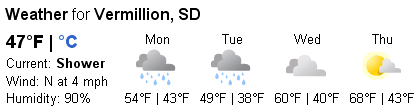
April in Vermillion looks cold and wet, a boon for checkered farmland visible from Google Earth. And somewhat more tranquil than the forecast for RBM's last departure from Colorado.

via Google

Thursday, April 07, 2011

Communication Can Save Lives

via Janice Mount for the Coloradoan
A guest column by RBM about the Crystal Fire, which has destroyed homes near Colorado State University, raised questions about air and water quality in the region, and made national news, but received no mention in the university's communications with students, appears today in The Coloradoan. An excerpt:
The Crystal Fire has reminded me, an instructor at CSU, of an embarrassing, even dangerous breakdown in communication. I live on campus, and like my neighbors, I woke up about 5 a.m. on Sunday thinking my building might be on fire. Nope. But the smell of burning wood was palpable, if not overwhelming. So I went online.

"Safety Information: Report of Possible Peeping Tom." This March 30 e-mail, about yet another man leering at women on campus, is still the last advisory I've received from CSU's "Public Safety Team." Thinking I must be missing some mention of the fire, I left my inbox for ColoState.edu. "Teeing Up for Golf's Greatest Tournament," read the news at the university's homepage, about former CSU golfer Martin Laird.

What gives, CSU Public Safety Team? I don't like telling people how to do their job, but I'm also bothered by something I've learned from watching the past decade's string of terrorist plots and natural disasters. It's that robust communication can save lives, reassure parents and prevent similar mayhem. That's where I feel CSU staff missed the mark on Sunday.

This isn't to say that apprehending peeping toms isn't important, or that the Crystal Fire has put CSU students in danger. That's beside the point. What I am saying is that CSU can better utilize the tools at its disposal to inform the campus community, in real-time, about the status of emergencies that affect us all.
You can find the full text of RBM's column on page A6 of today's paper and at this permalink.


Update (May 17, 2012) -- One year later, the university's public safety team has posted a helpful advisory on the Hewlett Gulch Fire, another pernicious blaze blackening the hills northwest of campus.

Saturday, February 05, 2011

Negotiating the Personal/Academic Divide

Ganges Composition
RBM presented "Negotiating the Personal/Academic Divide: A Bibliographic Essay" at today's Intermountain Graduate Conference in Pocatello, Idaho. This year's interdisciplinary gathering on "Challenging Boundaries, Seeking Intersections" was co-hosted by Idaho State University and Utah State University.

At left: "Ganges Composition," a map of composition pedagogies RBM developed in support of the essay, based on satellite imagery of temperatures in Mars' Ganges Chasma.

Tuesday, June 15, 2010

Exit Osh (Updated)

Volunteers reach the safety of a helicopter in Osh
By R.B. Moreno

I came to Central Asia to teach English, live among local people, and tell their stories. So this life in a compound near Bishkek that offers Gatorade and cable TV feels a bit unnerving. For the second time in as many months, I find myself behind barbed wire, along with other U.S. Peace Corps volunteers evacuated from provinces rocked by what newspapers have called ethnic cleansing. Our exit from Osh, Kyrgyzstan’s jewel of the South, says something about what is happening there.

Over two days, ten aid workers gathered in safe houses on both sides of the conflict. When our food ran low, neighbors smuggled us bread and tea and refused to be compensated. But others sent rocks through our windows and demanded bribes. And all the while, bands of young, ethnic Kyrgyz, enraged by rumors of students having been raped, terrorized the streets around us. They ransacked Uzbek apartments. They torched markets and restaurants. They burned vehicles, piled them into barricades, and shot at those trying to escape the city. By night, gunfire and screaming mixed with thunderclaps.

At last two hired cars arrived to get us to an airfield. The drivers wore bandanas; one carried a hatchet, another a hunting rifle. But there was confusion about where to rendezvous with another convoy. And so for 20 long minutes we sat exposed on burning Lenin Street. Smoke and sirens hung in the air. Rioters sped past carrying metal pipes, even a bow and arrow. Most of our cell phones didn’t work. Every time I shifted my legs, the volunteer pinned beneath me became asphyxiated. Another suggested running headlong toward a city park.

Presently, a dark sedan cruised by, pulled a U-turn, and came back for another look. Inside were three masked men and a Kalashnikov. This is what the trigger man wanted to know: Were there Uzbeks behind our tinted glass? “If any of you are Uzbeks we will kill you all,” he cried. No, no, just Americans, said the man with the hatchet. Show me, said the trigger man. And so my door was yanked open, and the trigger man raised his gun. For a moment we locked eyes – his glittering, angry, undecided. “No Uzbeks!” I repeated in Kyrgyz, my voice catching. Then the sedan's engine roared, and they were gone.

Minutes later we boarded a bus and began to roll slowly, behind a tank, through neighborhoods whose destruction we had only glimpsed earlier. Some passengers gasped at the shells of nightclubs, warehouses, and other landmarks now reduced to ashes. But other foreign nationals sitting alongside us – from Denmark and France, among other places – looked ecstatic. As if by magic, we were quitting what had become, overnight, a godforsaken place.

It wasn’t over yet. At the entrance to the airfield, another face-off, this time with scores of men agitating for weapons and furious about our convoy. Shouted questions filled the air. Who’s aboard the bus? Are they taking pictures? Rocks and sticks began to pelt our windows.

“Just smile at them,” said one woman. Instead, we cowered on the floor. And then the unthinkable happened: guns snatched from nervous troops huddled aboard the tank.

This is it, I thought to myself. What will a bullet feel like?

“I love you,” said another woman next to me, to her friend. Both began to cry.

A long volley rang out. But we could feel no pain. By some miracle these were warning shots, aimed at the clouds. Again an engine roared. And we were through.

As two helicopters lifted us skyward and circled Sulayman Mountain, a barren rock ringed by a cemetery that juts skyward from the middle of Osh, the scene became apocalyptic. Towers of black smoke marked Uzbek neighborhoods engulfed in flames. Much of the Cheremushki district appeared to have vanished. Some buildings glowed orange; others collapsed as we passed over head. Pushing north, with the sun setting, Osh became a terrible blur on the horizon.

It’s been three days since our evacuation, and for some, a creeping sense of guilt has begun to build. It comes in the form of a question no counselor can satisfactorily answer: By what twist of fate did we deserve to escape such carnage, while others perished? Two of the drivers who ferried us between safe houses, I'm told, were shot or beaten to death. Some 100,000 refugees have streamed west to safety in Uzbekistan, only to have the border shut and some of their children trampled in a stampede.

Calls to friends in Osh tell of still more suffering: empty food stalls at the bazaar; snipers picking off Uzbeks from atop Sulayman Mountain; a mother seven months pregnant dying of thirst on a rooftop; a Pakistani student, mistaken for an Uzbek, shot and beaten to death in the street. Although the official death toll stands at 138, locals tell of hundreds already buried and more bodies yet to recover.

“I wish I could have pushed some magic button that would have saved everyone,” one volunteer told me yesterday. “I can take no pride in having been evacuated.”


Postscript (July 1, 2010) -- After being removed temporarily at the request of the U.S. Peace Corps, this post has been republished. Excerpts are also available at NPR's blog.

Wednesday, May 26, 2010

RBM Goes South


Above: incoming volunteers gather around a giant map of Kyrgyzstan to await news of their permanent assignments.

RBM is to assist instructors at a university in Osh, Kyrgyzstan's oldest city and the scene of power struggles in recent days, the Peace Corps announced today. Past volunteers posted to the same institution have co-taught subjects ranging from lexicology, grammar and phonetics to methodology, journalism and American literature. The local population of 300,000, “is a fabulous mix of peoples,” notes Stewart and Weldon's Kyrgyz Republic (2008). Their entry continues:
A market town to its very heart, [Osh's] bazaar has apparently occupied the same spot on the banks of the Akbura river for 2,000 years. The rich history of the oasis lies hidden beneath the avenues of socialism and little remains to be seen. History's cultures, religions, and wars have disappeared from memory. The founding of the city is variously attributed to Alexander the Great, the Prophet Suleiman and even Biblical Adam. The most enduring tale is that of Suleiman who, when he reached the blade of rock at its centre, shouted “khosh” (“that's enough”).
Surrounding Osh is the Fergana valley, a verdant lowland renowned for its watermelons and framed by the Pamir Alay to the south and the Chatkal range to the north. With Uzbekistan just five miles to the west, enclaves also abound among the region's Uzbeks, Kyrgyz, Tajiks, Kurds, Uighurs, and other ethnicities. Physical isolation tends to exacerbate the valley's divisions, write Stewart and Weldon, along with "unemployement, poor housing, population pressure ... [and] the failure of the goverment to ensure fair and even distribution of land and resources."

"About 40 percent of the population of Kyrgyzstan's Fergana territory is Uzbek; people who report feeling like outsiders in Kyrgyzstan but who are considered Kyrgyz by Uzbeks in Uzbekistan. All of these destabilising influences make people more susceptible to the influence of Islamic extremism from the south."

Tuesday, March 30, 2010

The View from Bishkek


Above: primetime on local channel 12 and other scenes from Peace Corps training on the outskirts of Bishkek, Kyrgyzstan, where I've arrived to begin 26 months of service as an English instructor.

But for the howls of wild dogs traversing a nearby sculpture garden said to depict the Epic of Manas, the constant sunshine and biting cold here on the training compound remind me of Colorado’s Front Range. Breakfasts feature onion crepes and a thick, sour milk that I find delicious, while the mutton soup at dinner leaves a mean aftertaste.

After crash courses on Kyrgyz and safety protocols and a barrage of vaccinations, 70 trainees of K-18 (the latest wave of Peace Corps volunteers assigned to Kyrgyzstan since 1993) are to meet their host families this week in a ceremony marked by fresh flowers and speeches from local officials.

Key to language learning for the trainee is memorization of the Cyrillic alphabet, which makes the reading of grammar textbooks and the adoption of vocabulary doubly difficult. Still, the uniformity of the Kyrgyz language, which lacks articles and the myriad tenses of English, makes the going easier.

Friday, March 26, 2010

RBM's Teaching Portfolio


Colorado State University's Institute for Learning and Teaching (TILT) has awarded RBM a Graduate Teaching Certificate. His online portfolio, developed as part of the program, presents composition scholarship, curricula, evaluations, and personal reflections.

Tuesday, November 24, 2009

RBM Goes Abroad

By R.B. Moreno
This week I accepted an invitation to assist English language teachers in the Kyrgyz Republic, better known as Kyrgyzstan, as part of a Peace Corps Master's International (PCMI) partnership with the Colorado State University English Department. Kyrgyzstan is a landlocked country of some five million people that shares borders with China, Kazakhstan, and two former Soviet republics adjacent to Afghanistan.


Kyrgyzstan's territory encompasses the ancient Silk Road. The country is about the size of Nebraska, with a climate often compared to Colorado's higher elevations. The Tian Shan mountain range covers most of Kyrgyzstan, and winter snows sometimes leave outlying cities inaccessible. Conditions in the capital, according to Google, can also be challenging.


My teaching assignment will commence in March 2010 and is expected to last 26 months. Check back here for more dispatches about "the Switzerland of Central Asia." These sources, meanwhile, may be of interest:
A final note: this departure overseas will confirm a rumor aired last year by some dear friends at NPR's All Things Considered:
One of our own is heading off on international adventures, although he probably won't be dodging giant boulders or hunting crystal skulls. Our assistant producer, Raul Moreno, has apparently decided the Peace Corps is more exciting than working for All Things Considered. In all seriousness, we will miss Raul, and we wish him the very best in his adventures and we're betting he'll look really good in a fedora.
To donate said fedora, see "CONTACT RBM" in the sidebar.

Monday, August 03, 2009

College Composition: the Blog


By R.B. Moreno

In preparation for teaching two sections of first-year writing this fall, I've developed a new point of contact for students that will integrate Google's Calendar, News, and Docs, file-sharing site drop.io, and the Colorado State University Writing Studio. Look for an RSS feed of posts at College Composition elsewhere on this blog.

Friday, July 17, 2009

Collaboration in the Writing Classroom


"Collaboration in the Writing Classroom: Can Pedagogy and Technology Get Along?" is now available via Google Docs. The slideshow is part of a teaching demonstration RBM delivered to The Denver Writing Project in June.